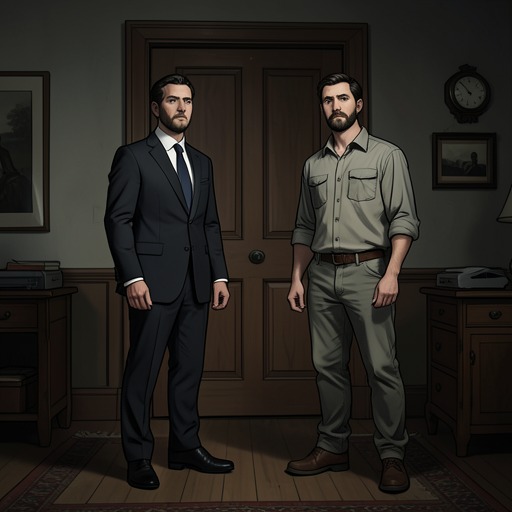
Tony McCall’s vulnerability to blackmail
Hide and SeekTony McCall’s vulnerability to blackmail is the hinge between a private fear and a public deception: afraid that photographs may reveal his association with Hyde’s Club, he allows Finlay Andrews to use that uncertainty to secure his cooperation in staging Ronnie McGrath’s death as an overdose. His exposure does not depend on the photographs being shown or even definitively confirmed to exist. The possibility that they might is enough to make silence, complicity, and the hope of advancement seem safer than refusal.
The secret and its leverage
Tony’s account to John Rebus begins with his brother, Tommy McCall, who had taken him to Hyde’s Club once. Tony says that he found the experience disturbing and did not stay. Even so, he fears there may be photographs of him there. The evidence does not establish what any image showed, whether a photograph of Tony actually existed, or how much of its contents Andrews knew. What matters to the pressure exerted on Tony is that he cannot rule out exposure.
Tony also connects his anxiety to difficulties at home and to having sought what he describes as a bit of fun, while keeping quiet because he does not know who already knows. His secrecy is therefore sustained by uncertainty about the audience for a possible disclosure. He does not describe a confident attempt to challenge the threat or discover the full extent of the evidence; instead, the possibility of being known is itself a constraint. The photographs function as leverage because Tony has reason to fear their circulation and cannot be sure that they are harmless.
From exposure to complicity
Andrews’s approach is enabled by Tony’s connection to Tommy. Tony explains that he and Andrews had met through Tommy, and that Andrews asked him for a favour because Pilmuir Estate was Tony’s beat. This joins private leverage to police access: Tony is not simply a person caught in Andrews’s social orbit, but an officer positioned to assist with an act connected to a death investigation.
The favour was specific. Tony placed a packet beside Ronnie McGrath’s already dead body, helping support the appearance of an overdose. He says he did not ask why Andrews wanted it done. He also reduces Ronnie to an addict and a person of little worth, a judgement that makes participation easier to excuse: in Tony’s account, Ronnie was already dead, and the task seemed limited to placing the packet. That narrowing of responsibility conceals the consequence of the act. The packet could influence how the death was interpreted, turning Tony’s assistance into part of a misleading scene rather than an inconsequential favour.
Tony’s explanation shows how the threat operated alongside inducement. Andrews had the photograph, Tony says, but also offered the prospect of membership at Hyde’s Club. Tony understood that membership could bring him into proximity with powerful people and even began to imagine advancement in his career. He presents himself as a small figure in a small world, attracted by access to people with greater influence. The offer does not erase the pressure of the photograph; it gives him a reason to cooperate while the risk of refusal remains in the background.
Confession and decision to help
When Rebus later asks Tony for help, Tony breaks down and admits that Tommy took him to the club and that he fears there may be photographs. His account of home troubles, secrecy, and the favour Andrews demanded comes out without Rebus needing to press him for every detail. The disclosure makes Tony’s role legible not as an isolated procedural lapse but as an act produced by overlapping fear, opportunity, and self-interest.
Tony does not simply hand over the image or settle the question of what it contains. After discussing the danger that Andrews might expose people rather than keep names secret, he lets pieces of a photograph fall into an ashtray and burns them. The gesture destroys those fragments but does not, on the available evidence, establish whether other copies exist or whether the underlying vulnerability has been eliminated. Tony then explains that Andrews had asked him for a favour and acknowledges that the photograph was part of why he complied. Rebus accepts Tony’s warning about the possible photographs, but continues with his plan whether Tony participates or not. Tony nevertheless agrees to help.
Institutional and narrative significance
Tony’s vulnerability helps show how the deception surrounding Ronnie’s death could be sustained through ordinary relationships and small acts of assistance. Andrews reaches Tony through Tommy, uses Tony’s Pilmuir beat as a reason to involve him, and combines a potentially compromising image with the offer of entry into Hyde’s Club. Tony’s fear concerns private exposure, but the consequence is public: his placement of the packet helps misdirect attention from the circumstances of Ronnie’s death. The act also demonstrates how an uncertain secret can still have practical force when the person threatened cannot verify what the other party possesses.
The later public account of the scandal remains narrow. Finlay Andrews’s club is described as not strictly legitimate, but the details of its activities are left undisclosed; the deaths of Andrews and Malcolm Lanyon are reported, while the connections among the men remain blurred. Tony’s episode belongs to that larger pattern of concealment: a photograph can be powerful without becoming public evidence, and a favour can help shape an official impression without exposing the network that prompted it. His confession gives Rebus a clearer account of one link in that chain, but it does not by itself undo the larger suppression.